Geometry of duration representations
Similarity judgments · EEG
Geometry of duration representations
How are durations organised in the mind and brain? Similarity judgments and an EEG oddball detection task reveal a richer structure than a single timeline.
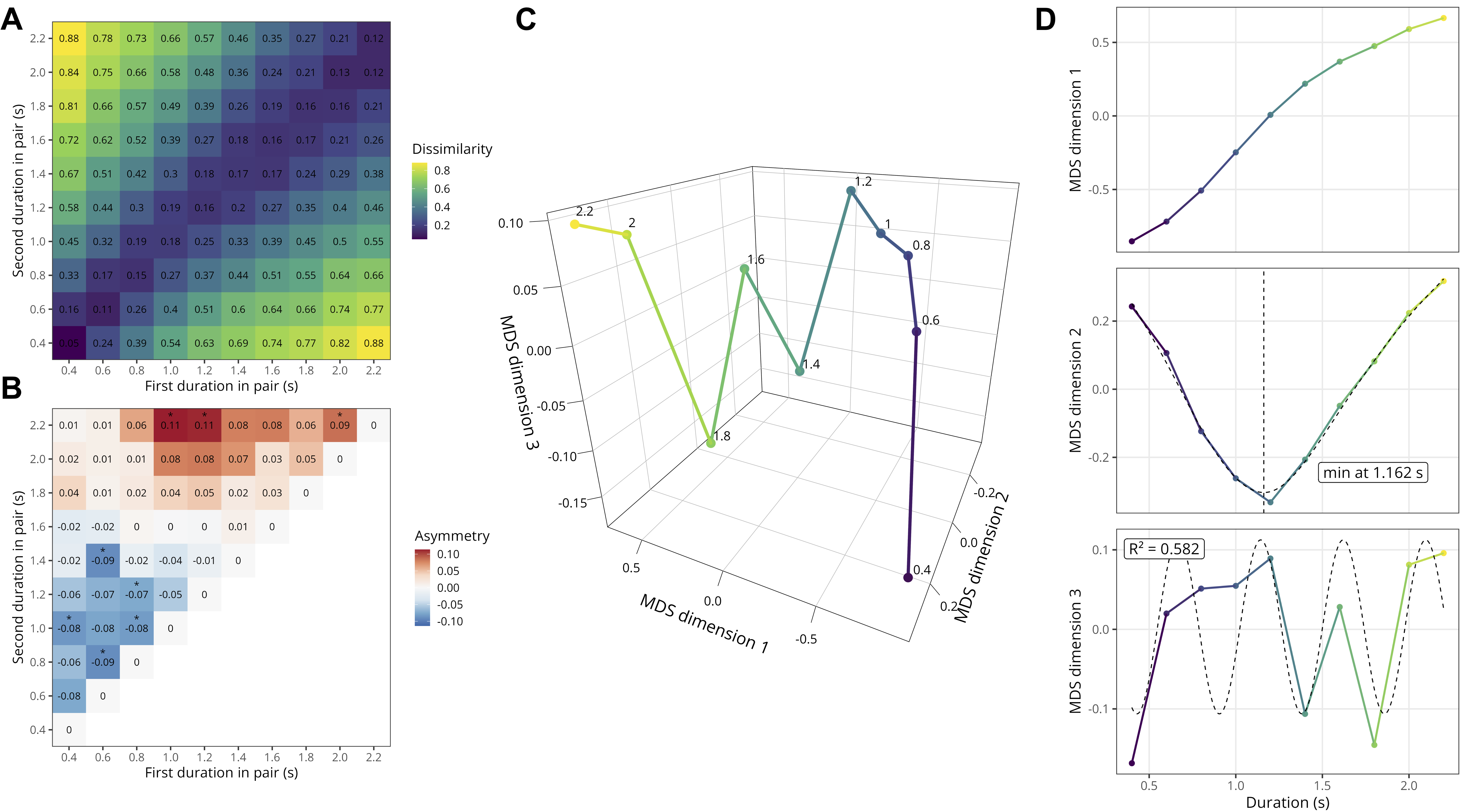
If durations can be ordered from short to long, does that mean that we represent them along a single mental timeline? To address this question, the same participants judged the similarity of auditory durations and later completed an EEG experiment with the same intervals. Using representational similarity analysis (RSA), we compared the structure of behavioural judgments and neural activity with competing models of duration representation.
The behavioural data revealed a structure richer than a simple line, combining a monotonic magnitude component with contextual and recurrent structure. A generalised helical model captured these properties well, although it could not be clearly distinguished from a nonlinear Power model. The results therefore point to a multidimensional organisation of duration rather than to one definitive geometry.
The EEG results showed that this organisation also changes over time: an early compressed, approximately logarithmic representation was followed by a richer geometry that became more closely aligned with behavioural similarity around 300 ms after duration offset. Together, these findings suggest that duration representations are both structured and dynamically transformed in the brain.
Follow-up studies are under way, including a related task with judgments of sound pitch and tests of new hypotheses about how durations are represented.

People and publications
I developed this work with Ladislas Nalborczyk and Virginie van Wassenhove during my postdoctoral research at NeuroSpin. The manuscript is under revision; a preprint is available.